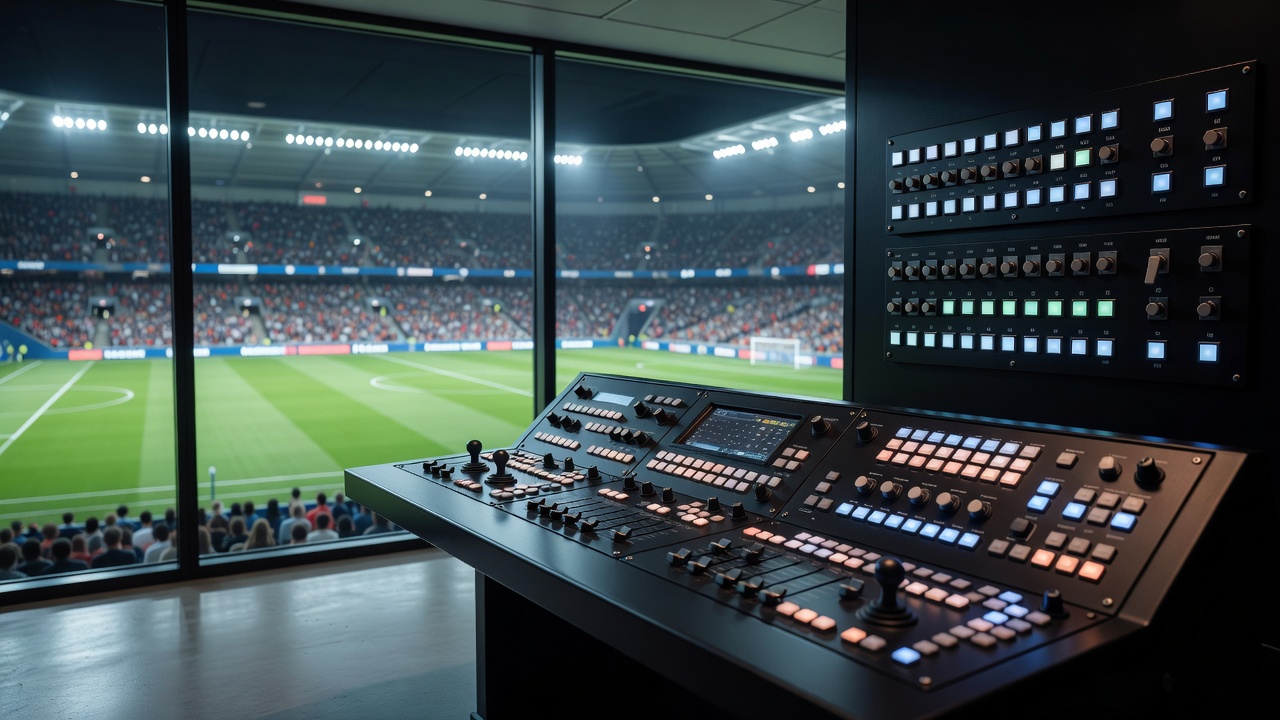
Start with operational scenes, not hardware specs
Metal halide floodlights dictated the rhythm of stadium operations for half a century because they needed ten to fifteen minutes to warm up and could not restrike immediately after a dip in voltage. Groundskeepers routinely left full match banks burning for hours around a brief evening training session simply to avoid thermal cycling penalties. Solid-state LED drivers remove that lag, permitting instant switching and smooth linear dimming down to single-digit percentages.
Yet hardware capability only yields practical benefit when mapped to a concise, disciplined schedule of operational scenes. Most multi-use grounds operate smoothly with six to eight locked presets rather than hundreds of ad-hoc sliders:
- Groundskeeping & Cleaning (10%–15%): Uniform low illuminance for mowers, turf repair, and stadium cleaning crews without waking the neighbourhood.
- Half-Pitch or Youth Training (25%–35%): Energises only the active zone at EN 12193 Class III levels while keeping unused halves dark.
- Club Match / Non-Televised (50%–65%): Delivers crisp Class II or Class I horizontal and vertical balance without broadcast overhead.
- Broadcast Competition (100% Maintained): Activates full four-plane vertical uniformity and verifies flicker-free driver state prior to kick-off.
- Spectator Ingress & Egress: Coordinates bowl seating, stair nosings, and concourse pathways so crowd movement proceeds without blinding transitions.
- Curfew Shutdown: Timed gentle ramp-down that automatically steps pitch lighting off after scheduled matches while preserving essential security paths.
Choosing open protocols over proprietary islands
Stadium roofs remain in service for twenty years or more, far longer than any single smartphone operating system or cloud subscription. Specifying open, non-proprietary communication standards protects facility managers against vendor lock-in and simplifies maintenance across separate contractors. In contemporary arenas such as Johan Cruijff ArenA in Amsterdam and Tottenham Hotspur Stadium in London, field lighting commonly uses DMX512-A (ANSI E1.11) distributed over Ethernet via sACN (ANSI E1.31) for high-speed scene transitions and optional show cues, paired with RDM (ANSI E1.20) for two-way diagnostics such as driver temperature and operating hours.
Meanwhile, bowl walkways, hospitality suites, concourses, and exterior plazas generally rely on DALI-2 (IEC 62386), KNX (ISO/IEC 14543), or BACnet (ISO 16484-5) so lighting communicates cleanly with heating, ventilation, access gates, and energy metering inside the Building Management System (BMS). The cleanest designs bridge these worlds through dedicated, cyber-segmented gateway hardware: the show desk can run pre-match scenes on cue, yet the BMS and life-safety panel always hold higher priority.
- Deterministic Priority Hierarchy
- Life-safety and emergency power triggers override every architectural and entertainment input at the hardware relay or driver level, never waiting on software menus.
- Local Fallback Operation
- Every venue needs a hardwired wall station in the control room capable of recalling Training, Match, and Egress scenes if network switches or show servers go offline.
- Network Segmentation
- Lighting control VLANs should remain isolated from public Wi-Fi, ticketing, and broadcast media networks to prevent accidental packet floods or unauthorised access.
- Constant Light Output (CLO)
- Optional driver compensation that begins slightly dimmed on day one and gradually raises current over years to offset lumen depreciation, avoiding unnecessary initial over-lighting.
Theatrical effects without operational hazard
Instant dimming has encouraged venues to turn floodlights into dramatic pre-match light shows. Used thoughtfully, brief dimmed introductions build atmosphere for spectators before kick-off. Used carelessly, rapid strobing can distress photosensitive spectators, disrupt matchday medical teams, or leave stairwells dangerously dark while latecomers are still finding seats. Responsible show programming separates pitch luminaires from bowl egress lighting completely, enforces maximum modulation rates, and returns full broadcast illuminance well before players take their starting positions.
“A truly intelligent stadium control system makes the ordinary Tuesday training night effortless and guarantees the Saturday emergency override works in half a second.”
Operational principle drawn from CIBSE SLL Guide 4 & stadium safety management practice
Avoid equating connectivity with automatic savings
Control vendors occasionally market cloud telemetry as an automatic route to massive energy savings. In practice, a control system saves energy only when staff use appropriate scenes, booking schedules match lighting run-times, and luminaire zones reflect how the pitch is actually partitioned. A simple timeclock-backed scene wall station used consistently by groundskeepers frequently outperforms a complex cloud dashboard left permanently parked on 100% match mode.