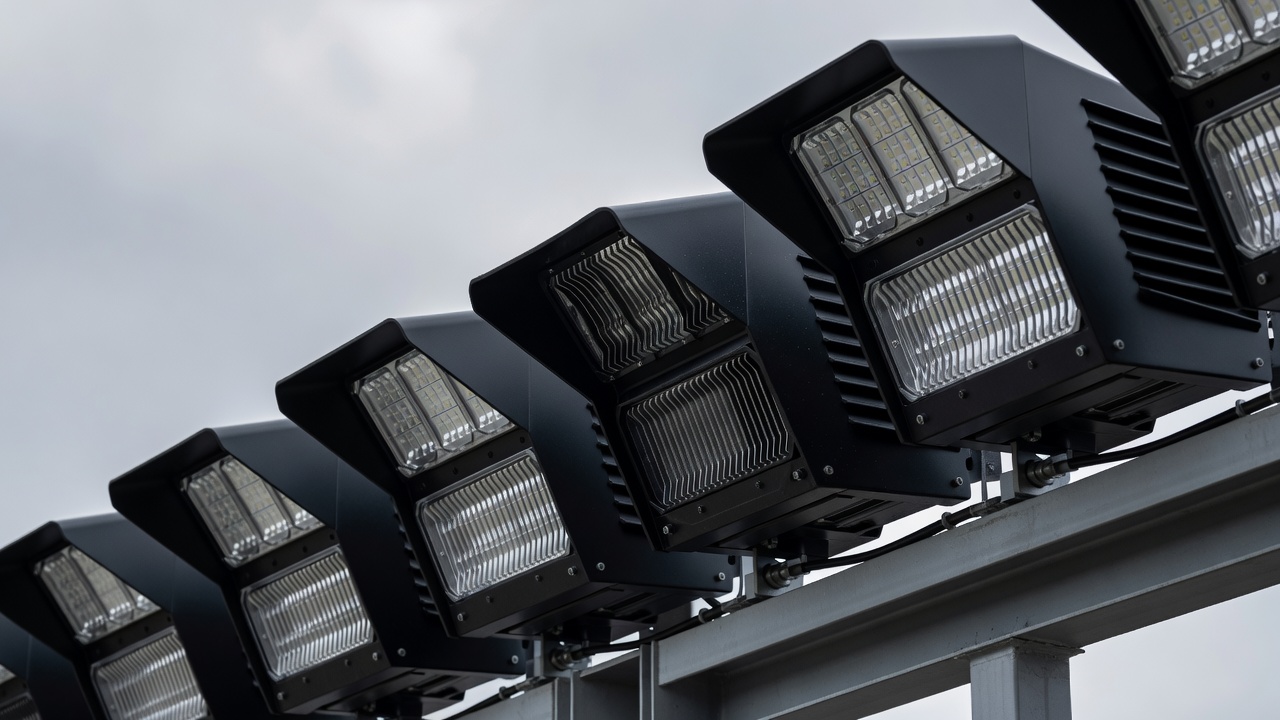
Geometry comes before catalogue selection
When a ground struggles with glare or boundary spill, the fault often starts in structural layout rather than luminaire brand. Masts set too low force designers to tilt floodlights upward toward the horizontal plane in order to throw light across the far touchline. Once aiming angles push past sixty-five degrees from nadir, intense luminous flux enters the direct field of view of players, spectators, and nearby residences. Increasing mounting height—or transitioning from four corner towers to continuous roof-edge catwalks—allows steeper downward aiming angles that deliver vertical illuminance cleanly while holding stray rays inside the stadium bowl.
Large architectural rebuilds illustrate the difference geometry makes. At stadiums with wrap-around canopies such as Allianz Arena in Munich or Strawberry Arena in Stockholm, perimeter gantries distribute optical loads across dozens of positions rather than concentrating immense luminance onto four corner clusters. By contrast, historic open-bowl venues like Helsinki Olympic Stadium must work carefully with heritage sightlines and mast locations, relying on custom combinations of ultra-narrow, narrow, and asymmetric optics to protect adjacent parkland and urban streets.
Asymmetric lenses, internal baffles, and glare control
Legacy high-intensity discharge (HID) projectors used large metal-halide arcs seated inside spun aluminium reflectors. Even well-made reflectors leaked a wide halo of uncontrolled spill light around the main beam. Solid-state LED luminaires pair compact emitters with injection-moulded silicone or polycarbonate secondary optics, shaping distinct rectangular or asymmetric distributions tailored to the exact aiming distance of each fixture on the headframe.
Yet LEDs introduce their own optical hazard: extraordinary surface brightness per square millimetre. Looking directly into an unshielded diode array creates sharp discomfort glare and momentary afterimages for goalkeepers and outfielders tracking high balls. Thoughtful optical packages counter this through three layered defences:
- Optical aperture sizing: Distributing total lumen output across a wider optical face lowers peak luminance seen from the pitch.
- Internal honeycomb or fin louvres: Precision matte-black baffles intercept stray off-axis rays before they leave the lens aperture.
- External cutoff visors: Top and side hoods trim upper-hemisphere emission near zero, lowering Upward Light Ratio (ULR) without blocking the target zone on the turf.
- Upward Light Ratio (ULR)
- The proportion of total luminaire flux emitted directly above the horizontal plane when installed. Tightly shielded asymmetric sports luminaires aimed near flat mount achieve near-zero ULR.
- Ev at Property Boundary
- Vertical illuminance measured at the windows of nearby residential buildings, governed by strict pre-curfew and post-curfew ceilings depending on environmental zone (E1 to E4).
- Luminous Intensity (Imax)
- Maximum candela directed toward potentially obtrusive observer points outside the venue, preventing distant glare even when illuminance lux values appear modest.
- Field-to-Spill Containment
- The percentage of total emitted lumens landing within the designated playing area plus safety run-off, an honest check against overspecified mast arrays.
Designing with neighbours and nocturnal ecology in mind
Sports grounds increasingly occupy dense mixed-use neighbourhoods or sit near river corridors and urban woodland. Under CIE 150 and CIBSE/SLL Lighting Guide 4 (LG4), planners assign each site an environmental zone ranging from E0 and E1 (intrinsically dark protected landscapes) through E2 (rural) and E3 (suburban) to E4 (high-activity urban centres). A suburban club ground in Zone E3 faces a sharp post-curfew window illuminance limit—often 2 lux or less—and residents notice bright masts long before a meter trips a threshold.
Spectral content matters alongside beam geometry. While televised elite grounds require neutral-to-cool white light around 5,000 K to 5,700 K to align with broadcast cameras, community and training facilities that do not host live television can consider warmer correlated colour temperatures (3,000 K to 4,000 K) where governing bodies permit. Lower short-wavelength blue emission reduces atmospheric Rayleigh scattering—the primary driver of urban sky glow—and moderates disruption to nocturnal insects and migrating birds near parklands.
“A neighbour rarely objects to a game being played; they object to a floodlight aimed straight across their curtains an hour after the final whistle.”
Community planning principle reflected in DarkSky International outdoor sports guidance
Balancing spill hoods against wind load and structural weight
Adding deep external visors to thirty luminaires on an existing mast is never a purely optical decision. Visors increase effective projected area (EPA), raising wind drag on towers and roof trusses during winter storms. Responsible lighting engineers coordinate directly with structural engineers before finalising shielding kits, sometimes choosing a slightly larger luminaire count with flatter horizontal mounting and internal optical cutoff instead of oversized external shrouds that would overload older steelwork.