Commissioning begins where software simulations end
Photometric calculation models offer indispensable foresight during design, yet real structures always introduce slight tolerances. Roof trusses deflect under load, bracket bolts shift by a degree during rigging, and a single luminaire aimed two degrees too high can open a bright band along one touchline while starving the opposite penalty box of uniformity. Rigorous post-installation commissioning therefore treats on-site aiming and verification as core engineering phases rather than casual walk-throughs.
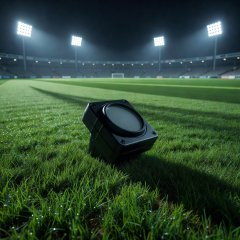
During night-time commissioning, engineers establish the exact measurement grid required by EN 12193, FIFA, or the World Athletics Track and Field Facilities Manual—commonly 88 to 96 grid points across a full football pitch, measured at ground level for horizontal illuminance and at 1.0 to 1.5 metres elevation for vertical camera planes. Using a cosine- and colour-corrected Class A photometer with current calibration certification, the team records initial illuminance, verifies uniformity ratios U1 and U2, checks colour temperature consistency across quadrants, and conducts perimeter spill readings along neighbouring street lines.
Honest maintenance factors and thermal realism
Every luminaire loses output gradually over its service life due to LED lumen depreciation (LLMF), driver survival rates (LSF), and dirt accumulation on optical lenses (LMF). Under CIE 154 and IEC 62722-2-1, designers combine these variables into a Maintenance Factor (MF)—often between 0.80 and 0.90 for well-sealed outdoor IP66 LED sports projectors cleaned on a planned schedule. An installation targeting 1,000 maintained lux with an MF of 0.85 must deliver approximately 1,176 initial lux at commissioning, or employ Constant Light Output (CLO) programming that holds output steady at 1,000 lux while gradually increasing drive current over time.
Beware specifications that inflate maintenance factors to 0.95 merely to shrink luminaire counts on tender spreadsheets. Coastal stadiums exposed to salt spray, northern arenas facing freeze-thaw cycles, and industrial districts with airborne particulate quickly expose optimistic dirt-depreciation guesses. Equally critical is thermal engineering: high-power stadium luminaires dissipate hundreds of watts of heat. Clean passive fin channels that shed bird debris and snow protect LED junction temperatures and prevent premature yellowing of secondary optics.
- L80 B10 Rating
- Indicates the operating hours at which at least 90% of luminaires retain 80% or more of initial luminous flux at a specified ambient temperature. More meaningful than generic “100,000-hour” marketing headlines.
- Remote Driver Enclosures
- Locating electronic power supplies in accessible electrical rooms or lower mast cabinets separates the most serviceable component from high-altitude roof work.
- Surge Protection (SPD)
- Tall steel floodlight masts attract lightning-induced transients. Dedicated 10 kV–20 kV surge protection devices with visual end-of-life indicators prevent silent widespread driver damage.
- Optical Aiming Locks
- Mechanical degree scales and serrated tilt locks allow maintenance technicians to replace a damaged luminaire and restore exact aiming without re-commissioning the entire pitch.
Designing maintenance for real crews, not brochures
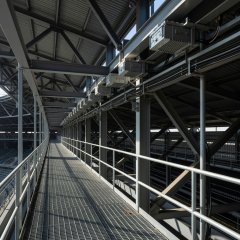
Long-term cost of ownership in a sports stadium is heavily shaped by access logistics. Hiring a specialist crane or deploying rope-access technicians across a 45-metre roof truss to swap a single failed power supply can easily cost more than the driver itself. Arenas built with serviceable catwalks—or community pitches equipped with mid-hinged raising-and-lowering masts—turn routine cleaning and component replacement into predictable half-day maintenance windows.
Telemetry from RDM or DALI-2 drivers supports this maintenance culture when configured thoughtfully. Rather than flooding facility teams with daily notifications, well-tuned diagnostics track cumulative burn hours per scene, flag abnormal driver temperatures, and report individual circuit outages well before a televised fixture exposes a dark corner on air. Annual visual inspections of mounting bolts, earthing straps, and visor fixings remain irreplaceable; software monitors electrons, not wind fatigue on galvanised steel.
“A well-documented aiming chart, a calibrated meter log, and an accessible driver room preserve lighting quality far better than any ten-year warranty brochure.”
Facility lifecycle perspective aligned with EN 12193 & IEC 62722-2-1 maintenance practice
Periodic re-verification across the venue’s life
Major governing bodies require periodic lighting certificates—often every one to three years for top-flight competition venues—to confirm maintained illuminance and uniformity remain compliant. Keeping the original commissioning grid coordinates, luminaire aiming schedules, and lens-cleaning intervals in a single permanent venue dossier turns re-certification from an anxious scramble into a calm, transparent audit.